
Many business owners believe that having a beautiful website is enough to attract customers and grow their business. While an attractive website creates a strong first impression, appearance alone doesn’t guarantee results. This is where understanding Website Design vs Website Strategy becomes essential.
A successful website is more than colors, images, and modern layouts. It should also support your business goals, guide visitors, answer their questions, and encourage them to take action. Whether your goal is generating leads, increasing sales, or building brand awareness, both design and strategy play important roles.
Unfortunately, many businesses spend their entire budget on design without creating a clear plan. As a result, they launch websites that look impressive but fail to bring in enquiries or customers.
In this guide, you’ll learn the difference between Website Design vs Website Strategy, why both matter, and how combining them can help you build a website that works as a valuable business tool instead of just an online brochure.
The Main Problem: Why Many Business Websites Fail

A common misunderstanding among business owners is believing that a good-looking website is automatically a successful website.
Imagine opening a beautifully decorated restaurant. The furniture is elegant, the walls are attractive, and the lighting is perfect. But there’s no menu, the staff don’t know what to do, and customers can’t find the entrance. Even though the restaurant looks amazing, people leave frustrated.
The same thing happens with many business websites.
A website may include modern colours, animations, and impressive images, but still fail to achieve its purpose because it lacks clear planning. Visitors arrive, become confused, and leave without contacting the business or making a purchase.
Some of the most common reasons include:
- No clear goal for the website
- Confusing navigation
- Slow loading pages
- Poor mobile experience
- Weak calls-to-action
- Content that doesn’t answer customer questions
- No search engine optimization (SEO)
- No plan for generating leads or sales
These issues are rarely caused by design alone. More often, they result from not having a proper website strategy before the project begins.
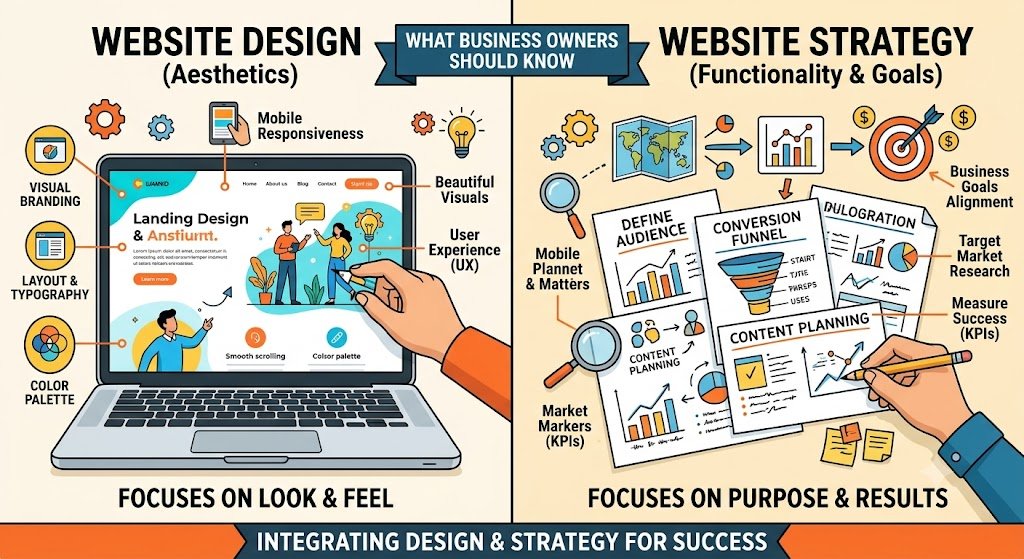
What Is Website Design?
When discussing Website Design vs Website Strategy, website design is responsible for creating a positive first impression and improving the user experience.
It includes everything visitors can see and interact with, such as:
- Layout and page structure
- Colours
- Fonts
- Images
- Icons
- Buttons
- Navigation menus
- Mobile responsiveness
- Overall user interface (UI)
Good website design creates a positive first impression. It helps visitors trust your business and makes your website enjoyable to use.
For example, when someone visits a professional company’s website, they immediately notice whether it feels modern, organized, and easy to navigate. Within just a few seconds, people often decide whether to stay or leave.
Good design improves:
- User experience
- Brand credibility
- Readability
- Mobile usability
- Accessibility
- Visual consistency
However, great design alone cannot guarantee business success.
A beautiful website without a clear purpose is similar to a luxury car with no engine—it looks impressive but doesn’t take you anywhere.
What Is Website Strategy?
A clear understanding of Website Design vs Website Strategy helps businesses make smarter decisions before the website development process even begins.
Instead of asking, “How should this website look?”, strategy asks questions like:
- Who is our target audience?
- What problems are customers trying to solve?
- What action do we want visitors to take?
- Which pages are most important?
- How will people find the website?
- How will we measure success?
A website strategy creates a roadmap before any design work begins.
It combines several important areas, including:
Business Goals
Every website should support specific business objectives.
Examples include:
- Generating leads
- Increasing online sales
- Booking appointments
- Growing an email list
- Building brand awareness
- Providing customer support
Without clear goals, it’s difficult to know whether the website is performing well.
Understanding the Target Audience
Different audiences expect different experiences.
A website for a law firm will look and function differently from an online clothing store. Similarly, a manufacturing company needs different information than a local café.
Website strategy helps identify:
- Customer needs
- Buying behaviour
- Pain points
- Frequently asked questions
- Decision-making process
This allows businesses to create content that genuinely helps visitors.
Content Planning
Many businesses treat content as an afterthought.
In reality, content is one of the most important parts of a successful website.
A website strategy determines:
- Which pages are needed
- What information each page should include
- Which keywords people search for
- How pages connect together
- Where calls-to-action should appear
Quality content builds trust while also helping search engines understand your website.
SEO Planning
Even the best-designed website won’t generate traffic if people can’t find it.
Website strategy includes planning for SEO from the beginning.
This means:
- Keyword research
- Website structure
- Internal linking
- Optimized headings
- Fast loading speed
- Mobile-friendly design
- Image optimization
- Meta titles and descriptions
Planning SEO early saves time and produces better long-term results.
Conversion Planning
The ultimate goal isn’t simply attracting visitors—it’s encouraging them to take action.
Depending on your business, that action could be:
- Filling out a contact form
- Requesting a quote
- Booking a consultation
- Purchasing a product
- Calling your business
- Signing up for a newsletter
Website strategy identifies where these conversion opportunities should appear and how to make them easy for visitors.
Why Website Design and Website Strategy Work Best Together
Many people compare Website Design vs Website Strategy as if they are competing ideas.
In reality, they are partners.
Website strategy decides what needs to happen.
Website design decides how it should happen visually.
Think of building a house.
The architect creates the blueprint, deciding where rooms, doors, and windows should go. Builders then use that plan to construct a beautiful home.
Without a blueprint, construction becomes chaotic.
Similarly, without strategy, even the most attractive website can struggle to achieve business goals.
The strongest business websites combine thoughtful planning with professional design. Strategy provides direction, while design creates an engaging experience that encourages visitors to trust your brand and take action.
In the next section, we’ll explore the 9 key differences between Website Design and Website Strategy, along with practical examples to help you understand why both are essential for business success.
9 Key Differences Between Website Design vs Website Strategy
1. Purpose: Looks vs Business Goals
The first difference in Website Design vs Website Strategy is purpose.
Website design focuses on making your website visually attractive and easy to use.
Website strategy focuses on achieving measurable business goals like generating leads, increasing sales, or building customer trust.
A beautiful website catches attention.
A smart strategy delivers results.
2. Focus: User Experience vs Customer Journey
Another important difference in Website Design vs Website Strategy is focus.
Website design improves the visitor’s visual experience.
Website strategy plans the customer’s entire journey—from landing on your website to becoming a paying customer.
Businesses that understand both create websites that are attractive and effective.
3. Success Measurement
Another key difference in Website Design vs Website Strategy is how success is measured.
Website design is often evaluated by its appearance, usability, and overall user experience. A clean layout, readable text, and mobile-friendly pages all contribute to good design.
Website strategy, however, is measured by business results, such as:
- More website enquiries
- Higher conversion rates
- Increased sales
- Better search engine rankings
- Longer visitor engagement
A website that looks beautiful but doesn’t generate leads or customers isn’t delivering real value. That’s why Website Design vs Website Strategy should always be viewed together.
4. Timing in the Project
Another major difference in Website Design vs Website Strategy is when each process begins.
Website strategy always comes first. Before choosing colors, layouts, or fonts, you should define your business goals, understand your target audience, and plan your website structure.
Once the strategy is clear, the design process becomes much easier because every design decision supports a specific purpose.
Starting with strategy also reduces unnecessary revisions and helps keep your project on budget.
5. Content Planning
Content is one of the biggest differences in Website Design vs Website Strategy.
Website strategy determines what information your audience needs, while website design determines how that information is presented.
For example, a strategy may recommend creating:
- Service pages
- About page
- Portfolio
- Blog
- FAQs
- Contact page
The design team then organizes this content into an attractive, easy-to-read layout.
Without valuable content, even the most attractive website struggles to build trust.
6. SEO Integration
SEO is another area where Website Design vs Website Strategy work together.
A strong website strategy includes keyword research, internal linking, optimized headings, and a logical site structure before development begins.
Website design supports SEO by improving page speed, mobile responsiveness, image optimization, and user experience.
When strategy and design are planned together, your website has a much better chance of ranking higher on search engines and attracting the right audience.
7. User Decisions
Understanding Website Design vs Website Strategy also helps influence customer decisions.
Design creates a positive first impression and builds credibility.
Strategy guides visitors toward meaningful actions, such as:
- Requesting a quote
- Booking a consultation
- Purchasing a product
- Contacting your team
An effective website doesn’t simply impress visitors—it encourages them to take the next step.
8. Long-Term Growth
One of the biggest advantages of understanding Website Design vs Website Strategy is preparing your website for future growth.
As your business expands, you may introduce new services, target different audiences, or launch new marketing campaigns.
A strong website strategy makes these changes easier because the website is built on a flexible foundation. Instead of rebuilding everything from scratch, you can continue improving and growing your online presence over time.
9. Return on Investment (ROI)
The final difference in Website Design vs Website Strategy is return on investment.
Professional website design is an investment, but strategy helps you get the most value from that investment.
When both work together, your website becomes more than an online brochure. It becomes a business tool that helps generate leads, build trust, support marketing campaigns, and increase revenue.
For long-term success, every business should treat Website Design vs Website Strategy as two equally important parts of the same process.
Practical Tips for Business Owners

Now that you understand Website Design vs Website Strategy, here are some practical tips you can apply before launching or redesigning your website.
Start With Clear Goals
Ask yourself what you want your website to achieve. Whether it’s generating leads, selling products, or increasing brand awareness, clear goals should guide every decision.
Know Your Audience
Understand who your ideal customers are and what information they need. Creating content that answers their questions builds trust and improves conversions.
Keep Navigation Simple
Visitors should be able to find important pages within a few clicks. Clear menus and logical page structures create a better user experience.
Prioritize SEO
Include keyword research, optimized page titles, internal links, and fast-loading pages ( Google PageSpeed Insights ) from the beginning. SEO is far more effective when it’s part of your website strategy instead of an afterthought.
Create Helpful Content
Instead of focusing only on promoting your business, publish content that solves customer problems, answers common questions, and demonstrates your expertise.
Review Your Website Regularly
Your website should grow alongside your business. Review your content, performance, and user experience regularly to identify opportunities for improvement.
By applying these best practices and understanding Website Design vs Website Strategy, you’ll build a website that not only looks professional but also supports your long-term business goals.
Common Mistakes to Avoid
Even after understanding Website Design vs Website Strategy, many businesses still make mistakes that affect their website’s performance. Avoiding these common issues can save time, money, and future redesigns.
1. Prioritizing Design Over Strategy
Many businesses invest heavily in creating an attractive website without first defining their goals. A beautiful website is valuable, but without a clear strategy, it may fail to generate leads or sales. Website Design vs Website Strategy is never about choosing one over the other—they should always work together.
2. Ignoring Your Target Audience
Your website should be built for your customers, not just for your business. If your content doesn’t answer customer questions or solve their problems, visitors are less likely to trust your brand or take action.
3. Forgetting SEO
SEO should be part of your planning process from the beginning. Waiting until after your website launches often means extra work and missed opportunities. A strong Website Design vs Website Strategy approach always includes SEO planning.
4. Having Weak Calls-to-Action
Every important page should encourage visitors to take the next step, whether that’s requesting a quote, booking a consultation, or contacting your team. Clear calls-to-action improve conversions and create a better user experience.
5. Never Reviewing Website Performance
A website isn’t something you build once and forget. Regularly review your traffic, conversions, page speed, and user behavior. Small improvements over time can lead to significant business growth.
How Fans Connector Can Help
Building a successful website requires more than attractive visuals. It requires planning, research, and a strategy that supports your business objectives.
At Fans Connector, we believe Website Design vs Website Strategy should always go hand in hand. Our approach focuses on understanding your business, identifying your target audience, and creating websites that are both visually appealing and results-driven.
Whether you need a brand-new website or want to improve your existing one, our team can help with:
- Website strategy and planning
- Professional website design
- SEO-friendly website structure
- Content planning
- Mobile-responsive development
- Website maintenance and optimization
The goal isn’t just to create a beautiful website—it’s to build one that supports your long-term business growth.
Ready to build a website that supports your business goals? Explore our Website Design services.
Conclusion
Understanding Website Design vs Website Strategy can completely change the way you approach your online presence.
Website design helps create a professional first impression and improves the user experience. Website strategy ensures that every page, every piece of content, and every call-to-action supports your business goals.
The most successful websites don’t focus on design or strategy alone. They combine both to create an experience that attracts visitors, builds trust, and turns potential customers into loyal clients.
Before launching your next website project, take the time to plan your strategy first. Once your goals are clear, design becomes much more effective and your website is more likely to deliver measurable results.
Ready to Build a Website That Delivers Results?
A great website is more than good design—it’s built on a smart strategy that helps your business grow.
If you’re planning a new website or improving an existing one, Fans Connector can help you create a website that attracts, engages, and converts.
Contact Fans Connector today for a free website consultation.
Frequently Asked Questions (FAQ)
1. What is the difference between Website Design vs Website Strategy?
Website design focuses on the visual appearance and user experience, while Website Design vs Website Strategy highlights that website strategy focuses on planning, business goals, SEO, content, and conversions.
2. Which is more important, website design or website strategy?
Both are equally important. Strategy provides the direction, while design creates the experience. The best results come when they work together.
3. Can I improve my existing website without redesigning it?
Yes. Many businesses improve their website by updating content, improving SEO, simplifying navigation, and refining their overall strategy without building a completely new website.
4. Why is website strategy important for small businesses?
A clear strategy helps small businesses attract the right audience, improve user experience, increase conversions, and make better use of their marketing budget.
5. How often should I review my website strategy?
Review your website strategy at least once a year or whenever your business introduces new services, enters a new market, or changes its marketing goals.